Rehab for a Calf Strain
This is a brief summary of an article that dives into how international experts handle calf muscle strains in elite athletes.
The experts shared their insights on assessing, managing, and preventing these types of injuries and came up with six key stages for effective calf strain rehabilitation.

What Do We Know About Calf Muscle Strains?
Calf muscle strains are common in elite athletes and can lead to significant time away from sports. If not managed well, athletes are prone to recurrent calf strains and other leg injuries.

Anatomy of the Calf Muscles
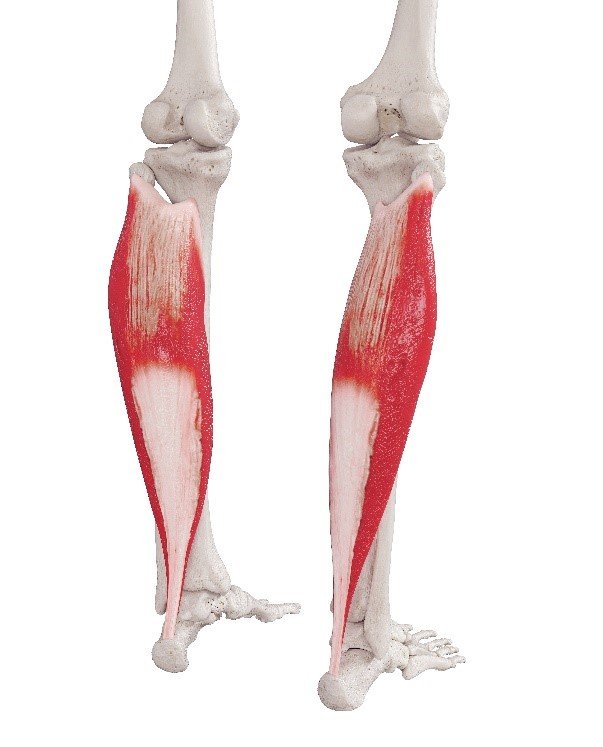
The calf complex includes the gastrocnemius, soleus, and the smaller plantaris muscles.
Gastrocnemius Muscle: This large muscle has two bellies stretching from the Achilles tendon to the back of the knee. It helps bend the knee and point the toes (plantar flexion). Made up mostly of fast-twitch fibers, it's crucial for powerful, high-intensity activities like sprinting and jumping.
Injury Insights
Gastrocnemius injuries often happen suddenly during high-intensity activities, causing acute, severe pain localized to one area. Severe injuries can make walking difficult or impossible, as putting weight on the leg becomes challenging.
Understanding and managing these injuries effectively is key to preventing recurrence and ensuring athletes can return to their sport safely and swiftly.
Soleus Muscle Insights
The soleus muscle, located beneath the gastrocnemius, is a broad, shorter muscle involved in ankle plantar flexion (moving the foot away from the body), especially when the knee is bent. Unlike the gastrocnemius, the soleus is made up of slow-twitch muscle fibers, making it essential for endurance activities like long-distance running.
Injuries to the soleus differ from those to the gastrocnemius. They often present as vague tightness or a cramping sensation, which can be easily overlooked. Endurance athletes are more prone to soleus injuries, especially with increased training volume. So, if you're upping your training time, keep an eye on that soleus!
Assessment of calf strain
There are a number of factors to consider during the assessment of someone with calf pain.
We first look at what the source of pain is, and which muscle is likely affected. In addition to ruling out other sources of pain (low back pain, or neural components).
Knowing how the injury occurred is a very important part of assessment- finding out if it was sudden onset or a slow build-up of symptoms.
Key Prognostic indicators/ things to consider post injury:
Can the person walk pain-free, and how long does it take for them to achieve this?
Where is it sore to touch- is it the gastrocnemius or soleus?
Is there a deficit in the amount of ankle movement?
What is the person currently able to do: can they single leg calf raise, can they jump/hop/or run?
What are the demands of the sport or activity the person wishes to return to? Do they need to do sprints, or achieve a high load/volume of training?
Other factors that can affect recovery:
Age
Previous calf injury
Prior calf weakness
Previous lower limb injuries
Six Key Phases for Calf Strain Rehab
-
Load the injured leg as early as possible
Get walking in whatever capacity as soon as possible
Progress exercises to single leg loading early, depending on pain/tolerance, and start small (eg: heel raises)
Don’t forget to exercise the hamstring as well (remembering that it works with the calf to flex the knee)
Start sports specific movements as early as possibleDescription text goes here
-
Start this once the person can tolerate load, and pain and irritability has decreased
Load at length – single leg heel raises through full range
Progressively increase the load by adding weights to the exercisesDescription text goes here
-
Before starting, the person needs to have good ankle range and strength
The calf muscles need to be powerful with consideration for the needs of the sport/goal of the patient
Thinking about exercises which involve: acceleration/deceleration, vertical and horizontal force production, change of direction and sideways/lateral movements as well
Start with skipping (small movements) or jogging on the spot on toes
Progress to larger movements, which could include: forward jumps, bounds, hops. Remembering to start with double leg and progress to single leg
-
Preparation for return to sport or return to running
Start with walking, then move to brisk walking, stair climbs, walking lunges and bear crawls
Soleus injuries – may need to start with short distance running initially and caution with when to progress the volume
Gastrocnemius injuries – there needs to be caution when considering when to begin fast running and higher intensity movements
Prior to return to running, patients should be able to – walk pain free for 30 minutes, jog on spot 1min pain-free, have normal ankle range of motion, have good calf strength and be able to hop
-
Before returning to sport, the following should be considered: no tenderness/pain on palpation, full strength, full range of movement, and good plyometrics
Make good decisions to ensure successful return to sport
Consideration for those who have a history of multiple calf injuries when returning to sport
When first starting back- can there be reduced game time?
-
To think ahead about successful rehabilitation and reducing risk of further injuries- management of calf tightness, any pain or tenderness are signs that things need to be backed off
Calf strains can reoccur in >50%, and therefore regular check ins with the physio to ensure the end stages of rehabilitation and load management are going to plan is very importanttem description
Key Take Away…
Calf muscle strains can be a real pain, especially if they're not managed well, as they tend to come back.
That's why a thorough assessment and a personalised rehab program with a Physiotherapist are crucial. Plus, keeping an eye on things after you return to your sport or activity ensures the best results.
Let's keep those calves strong and healthy!
Blog by Sheena Carey, Senior Physiotherapist
Reference:
Green, B., McClelland, J.A., Semciw, A.I., Schache, A. G., McCall, A., Pizzari, T. (2022) The Assessment, Management and Prevention of Calf Muscle Strain Injuries: A Qualitative Study of the Practices and Perspectives of 20 Expert Sports Clinicians. Sports Medicine - Open 8(10). doi: https://doi.org/10.1186/s40798-021-00364-0